Technical Insights / Blogs
Powering the AI Revolution: Solving the Heat Crisis in Next-Gen Data Center Cooling
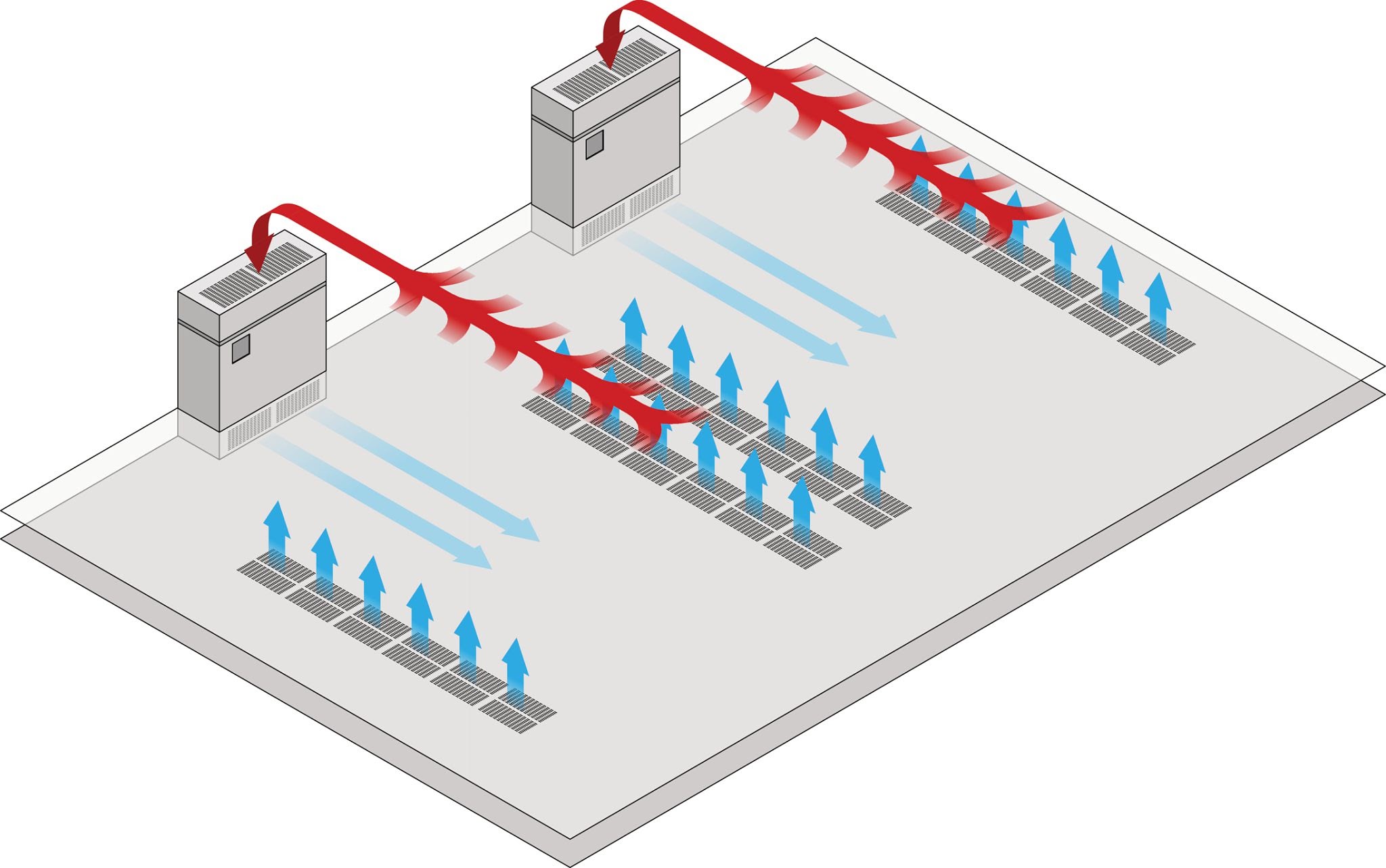
The rapid rise of large language models (LLMs) and deep learning accelerators has fundamentally altered the physical architecture of modern data centers. While traditional enterprise workloads require 5 to 10 kW per rack, high-performance AI clusters equipped with dense GPU nodes routinely demand 30 kW to over 100 kW per rack enclosure.Air-based cooling systems—long the standard in legacy facilities—are hitting absolute physical limits. Forced air simply cannot absorb or transport thermal energy quickly enough from modern microprocessors without consuming excessive amounts of electricity. As a result, thermal management has transitioned from a supporting utility into a critical strategic priority for modern data center operators.DLC places closed-loop liquid cold plates directly atop high-heat components (GPUs and CPUs). Coolant fluid circulates through delicate micro-channels, absorbing up to 80% of generated heat at the source before transporting it outside via secondary loop heat exchangers. Because liquid conducts thermal energy far more effectively than air, fan reliance drops significantly.As AI compute workloads continue their exponential growth, energy efficiency in cooling infrastructure is no longer just an environmental metric—it is an operational prerequisite. Embracing hybrid liquid-air architectures, warm-water cooling, and ML-driven thermal regulation enables data centers to scale performance reliably while maintaining cost-effective, sustainable energy targets.
View More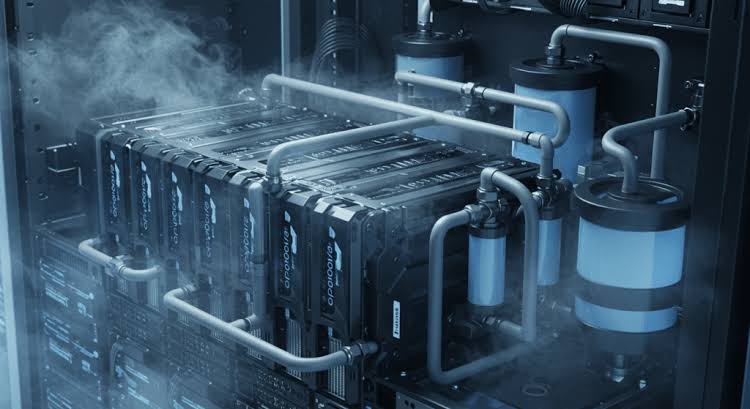
Thirst for Intelligence: Optimizing Water Efficiency in AI Data Center Cooling Systems
While the energy demands of artificial intelligence workloads—particularly large language model (LLM) training and high-density inference—frequently make headlines, the associated water footprint is an equally pressing environmental challenge. Thousands of high-TDP GPUs running simultaneously generate massive thermal loads that must be dissipated continuously.Historically, hyperscale data centers relied heavily on evaporative cooling towers due to their cost efficiency and thermodynamic effectiveness. However, evaporating millions of gallons of potable water daily places significant strain on local municipal watersheds and ecosystems. As water scarcity intensifies globally, achieving extreme water efficiency has become a foundational metric for sustainable AI deployment.By shifting from open evaporation to closed-loop Direct-to-Chip (DLC) or rear-door heat exchangers, data centers recirculate a fixed volume of treated liquid indefinitely. Heat captured from the chips is transferred via primary and secondary Coolant Distribution Units (CDUs) to dry coolers, eliminating continuous water loss.Modern data center infrastructure management (DCIM) tools leverage machine learning to dynamically balance the trade-off between Power Usage Effectiveness (PUE) and Water Usage Effectiveness (WUE). Depending on local weather forecasts, electricity grid carbon intensity, and water availability, AI algorithms dynamically adjust fan speeds versus adiabatic water spray in real time.Sustaining the growth of artificial intelligence requires balancing energy efficiency with water conservation. Transitioning to closed-loop liquid architectures, hybrid adiabatic systems, and intelligent multi-objective control algorithms ensures data centers can cool next-generation GPU hardware without exhausting vital local water resources.
View More.jpg)
Architecting Liquid Cooling Solutions for AI Data Centers
The transition from general-purpose CPU computing to dense GPU, TPU, and custom NPU clusters has broken the physical boundaries of air cooling. Modern accelerator architectures like NVIDIA Blackwell and AMD Instinct push individual chip thermal design power (TDP) toward 700W to 1,200W+ per socket. At rack-scale, power densities routinely exceed 100 kW per enclosure.Because air has a volumetric heat capacity of only 1.2 kJ/m3·K compared to water's 4,184 kJ/m3·K, air systems require immense fan power and high temperature differentials to reject heat. Liquid cooling, by contrast, transfers heat up to 24 times faster by mass and over 3,000 times faster by volume, making liquid cooling architecture a mandatory structural requirement for high-density AI deployments.DLC architecture attaches micro-channel copper or aluminum cold plates directly onto the IHS (Integrated Heat Spreader) of silicon processors. A closed primary loop circulates treated water/glycol mixture directly over the hot surface, capturing 70%–85% of total server heat. Remaining ambient chassis heat is handled by low-speed secondary airflow or rear-door heat exchangers.Liquid cooling raises exhaust fluid temperatures to 45°C–60°C (113°F–140°F). Unlike low-grade air exhaust, this high-grade liquid thermal output can be directly captured and repurposed for municipal district heating, industrial processes, or agricultural greenhouses, turning cooling from a cost overhead into a circular energy resource.As AI hardware advances toward multi-kilowatt processors, liquid cooling is no longer optional. Implementing robust Direct-to-Chip and Immersion architectures supported by intelligent CDUs allows operators to achieve unprecedented compute density, maximize reliability, and reduce overall facility PUE to historical lows.
View More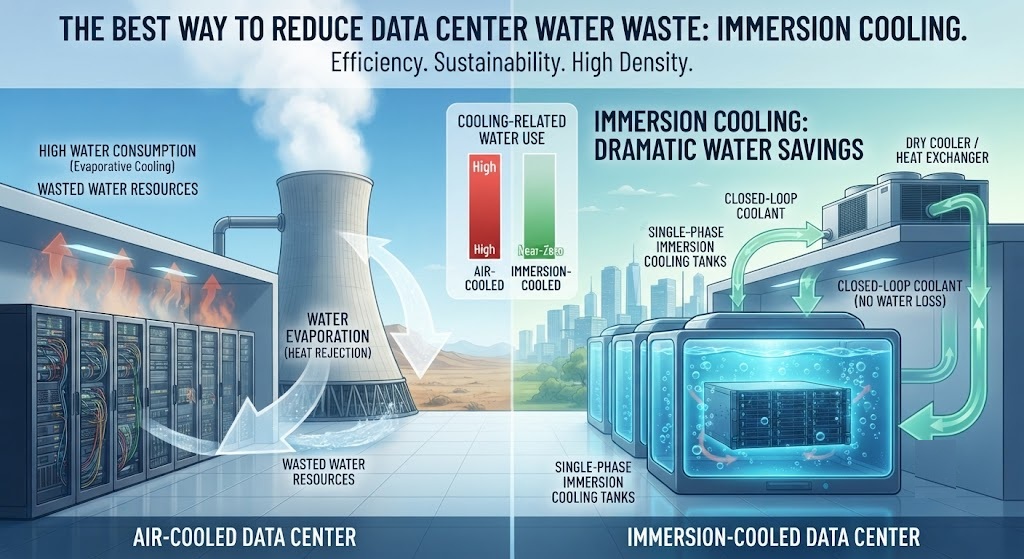
The Best Way to Reduce Data Center Water Waste: Immersion Cooling
ThermInfra’s Perspective on High-Density AI CoolingAI workloads are driving data center rack densities from tens of kilowatts to megawatt-scale systems, creating a major infrastructure challenge: how to remove massive amounts of heat without draining public water systems. While traditional evaporative cooling offers high energy efficiency, it continuously evaporates water, posing severe constraints in water-stressed regions and complicating site permitting and long-term expansion.To solve this, modern cooling architecture must decouple heat removal from water consumption using advanced, closed-loop systems. Air cooling remains mature and effective for low densities, but struggles with the sheer thermal output of modern AI accelerators, while direct-to-chip liquid cooling successfully targets high-power processors using closed-loop cold plates.Immersion cooling takes this evolution a step further by submerging entire servers in engineered dielectric coolants. Single-phase immersion surrounds the IT equipment in a recirculating fluid that transfers heat cleanly to a dry cooler or water loop, achieving high density, improved acoustic performance, and near-zero operational water consumption. Meanwhile, two-phase immersion leverages a controlled boiling and condensing phase-change cycle to deliver exceptional thermal performance for extreme heat-flux applications.Ultimately, the future of sustainable data center infrastructure relies on matching the right thermal architecture to each specific deployment. By integrating single-phase or two-phase immersion cooling with efficient heat-rejection strategies, operators can successfully balance energy efficiency, spatial density, and strict water conservation.Beyond managing water constraints, single-phase and two-phase immersion technologies fundamentally transform the physical and economic architecture of modern data centers. By eliminating the need for massive airflow infrastructure, high-speed server fans, raised floors, and complex air containment systems, facility operators can significantly reduce capital expenditures and save valuable floor space. This simplified mechanical layout also lowers parasitic power loads associated with air-handling units, directly improving the overall Power Usage Effectiveness (PUE) of the facility.Furthermore, these advanced cooling methods unlock new pathways for environmental sustainability through energy reuse. Because dielectric coolants capture heat at relatively high and stable temperatures, operators can redirect thermal waste toward district heating networks, agricultural applications, or industrial processes rather than simply rejecting it into the atmosphere. This capability turns data centers from energy-intensive burdens into active participants in local circular economies, proving that the next generation of AI infrastructure can achieve high-density performance while operating sustainably.
View More